A Morning That Changed Everything
Monday morning, December 8, 1941, was like any other morning. Stove, kettle, bowl, rice, seaweed. Yawn. Sat at her breakfast table, enveloped by the familiar scent of miso soup and tea. Takashi – her husband – had just left for work, unaware of how different the evening would be. Then the telephone rang.
A war had just been declared.
His words struck her with unbearable weight. The forgotten winters of Tokyo, hardened into ice. As Japan’s declaration of war against the US became reality, a flood of memories crashed over her. Faces of her American friends whirled past her eyes – the Clarkes, the Pococks, Mano, Twitter, Lynne, Kat – the others at Shaker Heights and Swarthmore. How could the two worlds she belonged to now stand in opposition? The certainty of her past now felt fragile, upended by geopolitical forces beyond her control.
The Swarthmore Years: Questioning, Learning, Becoming
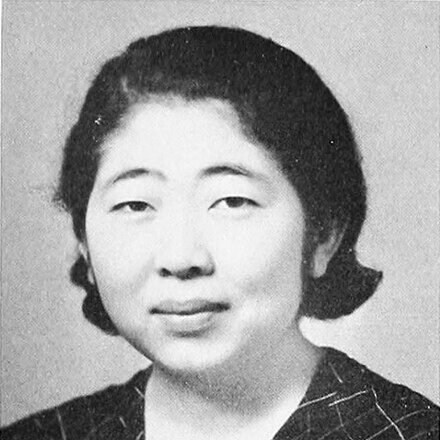
Yoko Matsuoka (1916 – 1979) had been destined for Swarthmore, though she had not realized it at the time. Her mother’s decision to send her to study in the United States in protest against the Johnson-Reed Act – an act designed to exclude immigrants from Asia and establish annual quotas based on nationality – was more than a personal act of defiance; it was a gesture of resistance against exclusionary policies. Swarthmore, known for its intellectual rigor and ethical enquiry, provided the fertile ground for her personal and intellectual evolution.
Arriving in 1935, Yoko immersed herself in the academic and social life of the college. A philosophy course in her freshman year destabilized her once-secure beliefs, compelling her to reexamine the nature of mind, soul, and faith. She found herself drawn to the Quaker tradition, attending meetings where silence often spoke louder than words. At first, the experience felt foreign, yet the simplicity and sincerity of these gatherings provoked deep contemplation. How could one define a God that eluded description? Could faith and reason coexist? This intellectual tension deepened her curiosity and planted the seeds of the critical inquiry that would define her work as a writer and activist.
Yet Swarthmore was not without its tensions. As Japan’s imperial ambitions grew, anti-Japanese sentiment spread across American campuses. A boycott of Japanese goods gained traction, and even her own roommate, Mano, a missionary’s daughter born in China, wore a boycott pin with pride. Though her actions were rooted in conviction rather than malice, Yoko felt the sting of isolation. She was the sole Japanese student on campus, bearing the weight of collective scrutiny. Yet, amid the ideological rifts, moments of grace emerged.
Twitter, another missionary child who boycotted Japan, found herself caught between loyalties. In her book Daughter of the Pacific, Yoko recounts one Saturday night her friend Twitter was getting dressed up to go out with her boy:
”Like other missionary children. She had very little spending money and to her dismay she discovered that she did not have a pair of hose. She came to ask me whether I would lend her a pair. Intentionally, I drew out my best pair of silk stockings, obviously a Japanese product, and presented them to her. She tenderly put them on her palm and seemed to ponder. After a few minutes, she returned them to me with a sigh and said, “Thanks just the same, Yoko.” For that, I appreciated Twitter all the more.”
Passage from Daughter of the Pacific by Matsuoka
These interactions, layered with tension and understanding, underscored the complexities of identity in a world increasingly defined by division.
Academic Excellence and Leadership
Graduating in 1939 with highest honors in political science, Yoko’s academic trajectory reflected both her intellectual prowess and her commitment to understanding the structures of power. Her thesis on Japan’s concept of sovereignty was a prescient examination of national identity and global politics. She had also founded and served as the first president of Swarthmore’s International Relations Club, fostering dialogue on diplomacy, peace, and cross-cultural understanding.
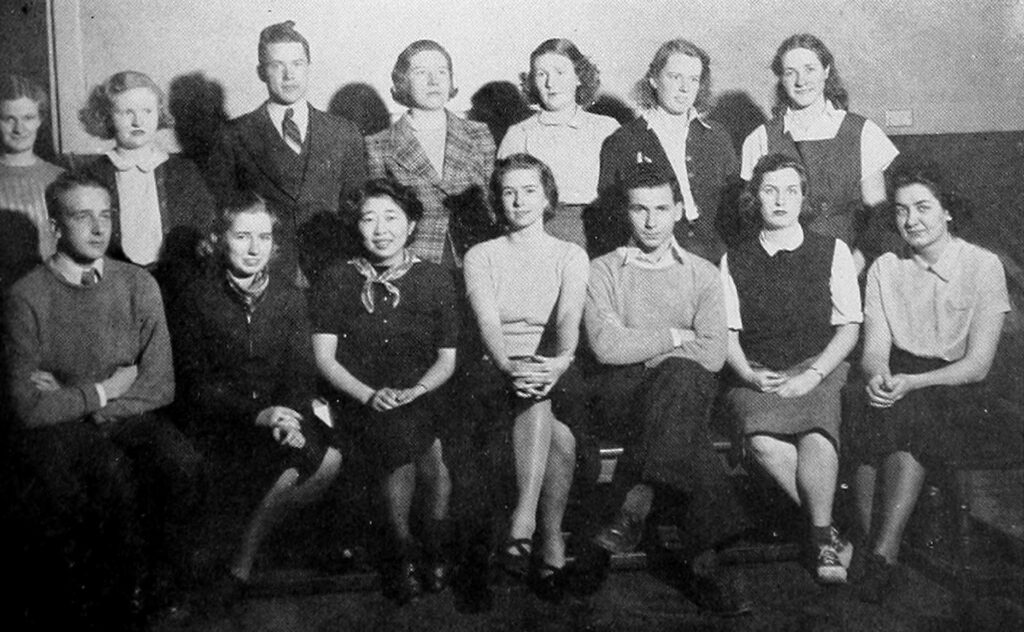
Elected president of the Middle-Atlantic Inter-Collegiate Conference of International Relations Clubs in 1937 and 1938, she established herself as a formidable advocate for international cooperation. Her time at Swarthmore was not just about academic growth-it was about cultivating a broader vision of international relations and engagement with the world.
Back to Familiar Shores
Returning to Japan, she confronted the contradictions of its social and political structures. “Life in Japan, I soon found out, was too uncomfortable to be accepted without question,” she later wrote. “I felt as if I were shut in a small cubicle where if I yawned I would bump the ceiling, and if I sneezed my nose would scratch the wall.” Even her books – intellectual artifacts of her Swarthmore years – were deemed subversive. Among those confiscated at customs was Lenin’s State and Revolution, assigned reading in her political theory seminar. She had placed the booklet at the bottom of her large trunk, covered it with underwear, old stockings and all sorts of odds and ends which she thought would be difficult to look through. Not for these officers, however. They were quite thorough. The ideological freedoms she had taken for granted at Swarthmore now seemed distant, replaced by an atmosphere of surveillance and restriction.
Yet, even in these times, Swarthmore’s influence persisted in unexpected ways. When American soldiers occupied Japan and advanced to Hanamaki, the police chief called upon her to act as his interpreter. She was the only one in the town who could speak English. Upon their arrival, one of the American lieutenants asked her where she had learnt her English, to which she answered that she graduated from Swarthmore College. “‘Oh! Swarthmore!’ he exclaimed as though that word had touched a forgotten memory,” she recounts. “That is a very good college.” When the GI’s arrived the following day, Yoko recalls the lieutenant instructing them and remarking, “Our interpreter is a graduate of Swarthmore College. You must respect her.”
Admittedly, I was pleasantly surprised when I read that account
In these moments, her education transcended national divisions, serving as a marker of shared values rather than enmity.
A legacy of Activism and Literature
In the decades that followed, Yoko Matsuoka emerged as a vital voice in cultural and political discourse. As a translator and writer, she bridged the linguistic and ideological gaps between Japan and the broader world. She worked as an interpreter for renowned foreign correspondents, including Keyes Beech and Edgar Snow, facilitating cross-cultural understanding in a fractured global landscape. Her activism extended beyond translation; she was a founding member of the Women’s Democratic Club in Japan, advocating for gender equity and pacifism. She later assumed leadership roles in the Japan Socialist Party and the Japan-China Friendship Association, continually challenging militaristic policies from all sides.
Her critiques were not confined to Japan. She was an outspoken critic of Cold War militarization, condemning both American and Soviet interventionist policies. She opposed the division of Korea and Vietnam, championing reunification and sovereignty for both nations. Her internationalism was not abstract; it was grounded in a lived understanding of war, occupation, and the fragile nature of peace. She traveled extensively, speaking at international conferences, urging dialogue between adversaries, and calling for new frameworks of peace and cooperation.
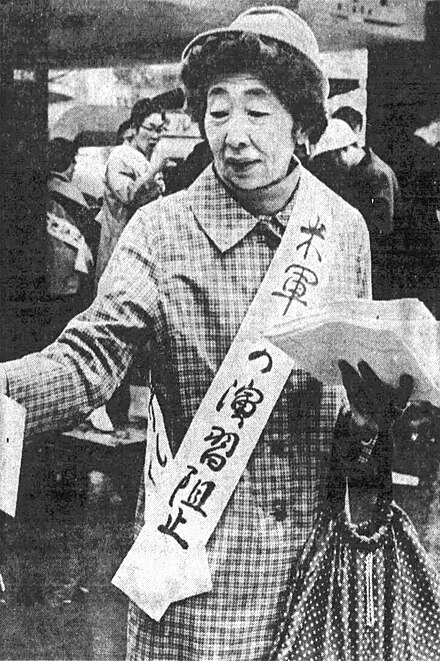
As an activist, she was equally committed to the cause of women’s rights. She played an integral role in Japan’s feminist movements, advocating for legal reforms, social equity, and the recognition of women’s contributions to political discourse. Her work with the Japan PEN Club further solidified her role in shaping Japan’s intellectual landscape. She was instrumental in organizing the Tokyo congress of PEN International, ensuring that Japan became an active participant in global literary conversations.
Swarthmore’s Enduring Legacy
Swarthmore had not merely educated her; it had provided her with a framework to navigate a world defined by conflict and transformation. It instilled in her a belief in dialogue, intellectual honesty, and the necessity of cross-cultural engagement. Despite the ideological battles she fought, she remained committed to fostering connections, believing that even in the aftermath of war, reconciliation was possible. Her life – spanning continents, ideologies, and revolutions – was a testament to the enduring power of education to shape not just individuals, but the course of history itself. Even decades after her time at Swarthmore, its influence on her remained evident, in her work, her advocacy, and her unshaken commitment to justice and peace.
Yoko Matsuoka’s story is not just one of inspiration but of connection. As international students, we see in her experiences a reflection of our own – the exhilaration of learning in a foreign land, the trials of adjusting to unfamiliar cultures, and the complexities of returning home to a changed world. She is not only someone to admire, but someone whose journey we can relate to on a profound level. Through her unwavering pursuit of justice and truth, she reminds us that intellectual courage and moral conviction can bridge even the deepest divides. In an era still marked by political upheaval and ideological strife, her legacy continues to illuminate a path forward for those who seek to engage with the world critically and compassionately.
Sources of information on Yoko Matsuoka’s life
Wikipedia
Daughter of the Pacific (Authored by Yoko Matsuoka)
Swarthmore College Catalogue 1936-1939
Leave a Reply