
———-
Packing. To put every little thing that holds significance to you in a bag or big suitcase. The emotions filling in and the panic unraveling as you reach the airport and realise that this might be a beautiful new chapter flourishing or a new one that spells doom.
Why begin here? Because for Sai Nyi Bhone Htut, airports marked blossoming chapters.
From Myanmar to Swarthmore
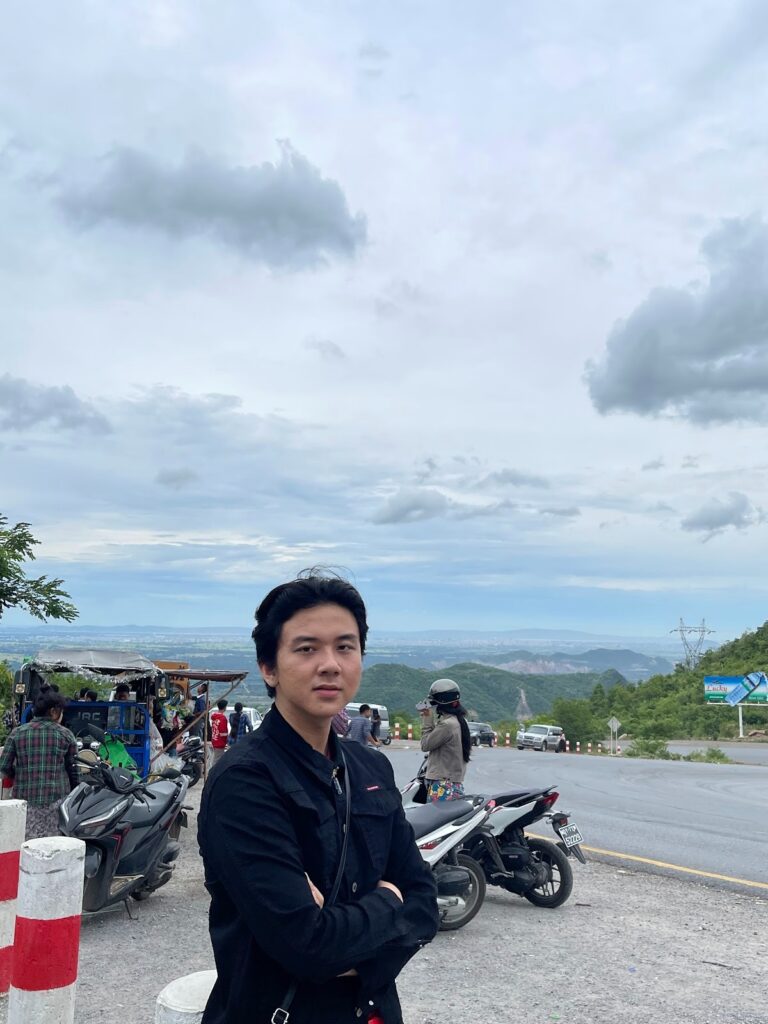
“Just to confirm, you’re originally from Myanmar, right?” I ask.
“Yes.”
“And you’re part of the Class of 2028?”
“Yes.”
He plans to declare his major as engineering. He tells me he was drawn to it not just for its analytical side, but for its creativity and most importantly its logical thinking.
Recently, he’s been especially interested in biomedical engineering, particularly medical devices and diagnostic tools, because of their potential to improve access to healthcare. At the same time, he remains aware that technology, even when designed to reduce inequality, can sometimes reinforce it but, as he puts it, “we do have to start somewhere.”
Studying in the United States was not always the plan. In earlier high school years, going abroad was more of a suggestion than certainty, teachers encouraged it, but it remained abstract. The intention was to pursue an undergraduate degree in Myanmar. Then in 2021, the coup d’état happened. The military takeover fractured more than a government; it disrupted classrooms, futures, the very idea of stability.
Sai began searching for international programs, focusing on institutions with strong financial aid for international students. But for Sai, what also mattered was interdisciplinary learning and building a community away from home. In his research, he found Swarthmore College, known for its academic rigor and close-knit support systems, “All things considered,” he tells me, “I decided to apply.”
First Impressions: Glitter and Care

When Sai arrived on campus, the beauty was immediate. The campus had an almost cinematic feel to it, with its undulating greenery and stonework. But what settled his nerves were not the buildings. It was his International Orientation Leaders. Warm, welcoming, quick to laugh.
There is a particular story he remembers from those first hours. He had arrived without bedding. It was a small oversight, the kind that feels enormous at midnight in a new country. Someone he barely knew, one of the co-presidents of i20 at the time, Andrea Cheah stepped in to help without hesitation.
“That stood out to me,” he says. It was such a caring gesture.
Adjustments
The first semester wasn’t seamless “it’s been so long,” he laughs. He recalls sitting in Willets Hall as domestic students casually referenced things he didn’t recognize, leaving him feeling subtly isolated in conversations shaped by a shared upbringing he didn’t have.
Yet, he learned that common ground is always possible. Like with his roommate, Evyn, raised in Montana while he grew up in rural Myanmar. Their only obvious similarity was mountain hometowns. However, the more they talked the more they found more profound similarities, and that initial distance was transformed into a tight, trustworthy bond.
Academically, the adjustment was just as stark. He had come from a strict learning environment. Here, professors invited students to call them by their first names. At first, it felt almost irreverent. Eventually, it felt liberating. He found himself more willing to speak, to connect, to exist without the pressure that once accompanied authority.
A Reimagined Home
When I ask what helped him feel at home, he pauses.
“Home is a very complicated idea,” he says.
With the political turmoil unfolding in Myanmar, the word does not always evoke comfort. Instead, he has begun redefining home as a feeling rather than a location. It is being around people who allow him to be fully himself, including being queer.
He emphasizes, “My friends have redefined what close relationships/friendships mean to me, and influenced me to be kinder to myself and to be myself. And that is what makes being around them feel like home. There is a sense of comfort. Given the state of my country, and that Myanmar is travel banned from the US, there is so much limitation as to what opportunities I can pursue, the future I can imagine for myself, and how soon I can see my family again. I never thought I would have to deal with these and their resulting mental turmoil but the support system I have now is also unmatched. They make it feel bearable, and keep me grounded. I’m very grateful for my friends.”
Little Moments that Matter
There are lighter memories, too. The seven-dollar airport trolley still makes him laugh. So does the serendipity of meeting his first Swattie, Rania, through a reply to an Instagram story during a layover in Doha. A digital breadcrumb leading to a real-life friendship.
Being an International Orientation Leader

Given how formative his own International Student Orientation (ISO) had been, becoming an International Orientation Leader felt natural. His ISO, he describes it as “a bliss.” The people he met then were present, attentive, grounding. He wanted to be that person for someone else.
Leading orientation came with its pressures, facilitating conversations, holding space for vulnerability but it was largely joyful. He felt more embedded in the i20 community, contributing in a way that felt meaningful.
One of his favorite orientation traditions? Creating montage videos with Elaina Pan, capturing fragments of joy: candid laughter, late-night camaraderie, the nervous excitement of new beginnings.
Advice
His advice to new international students is gentle but firm:
Do not isolate yourself. Seek the people who make you feel at home. New journeys do not always have to be centered around struggles and sometimes, certain changes might work out in your favor. Reflect on how you’ve changed. Notice your growth.
There is liberation here, he admits with a grin, liberation from certain expectations back home, from the ever-watchful “Asian aunties.” Growth sometimes looks like distance.
Three Words
If he had to distill his college experience into three words?
Expansive.
Community.
Reflective.
He clarifies that “expensive” first slipped out as a joke, but he meant expanding — broadening. His world has widened here.
A Reflection
Coming from a small town in Myanmar, Sai feels a responsibility to speak about what is happening back home. “Everybody comes from different backgrounds,” he says. “Never assume anything about anybody.”
On that note, he highlights, “On the second day of class in my freshman year, I turned 20. And that’s because I had an unconventional high school experience; I went to 3 different schools over 5 years, and my decisions were shaped by the political events and the economic state of my country. I don’t mind when people ask me why I was a 20 yo freshman, but it’s the way they would react or ask the question that made a difference; sometimes you can tell they’re just curious. Other times, it comes off a little bit rude or disrespectful. Swarthmore’s students come from very diverse backgrounds and sometimes they aren’t always visible. We should all be curious about our peers and friends to connect and empathize with them, but it is also important for us to make others feel seen, not singled out.”
What He Wishes He Had Known
Surprisingly, not much.
“Nothing could prepare you for a change of this magnitude,” he says. Studying abroad, especially when many factors lead you to it, is not simply an academic decision. Some students drove thirty minutes to arrive at Swarthmore. Others traveled ten-plus hours, crossing oceans and political realities. It is the beginning of a different future. The only way to understand it is to live it.
Leave a Reply