
A Conversation with Swarthmore’s beloved International Student Dean, Jennifer Marks-Gold, reveals the heart behind the support for international students
Strolling Through Memory to Sproul

I’ve recently found myself sitting with a friend in my room at Wharton Hall, sifting through high school memories (we went together). This sweet exercise, though infrequent, has sparked a more solitary habit: reconstructing the landscape of my alma mater from memory alone. It’s an odd feeling when the paths I took for more than 250 days a year for four years fail to emerge precisely, sometimes appearing like unfinished renders in a video game.
Why tell you this? Well, I love trifles. Trifles are the beginning of most things. And, secondly, I would like you to use your mind’s eye and walk with me to where our story begins. Assuming you’ve been a Swattie at any point since 1911, you can likely conjure an image of Sproul Hall, perhaps softened at the edges. Let’s sharpen that image. Walking down Parrish West towards Wharton, the road forks – take the slightly inclined path to the left. There it is – the curious building crowned with a green dome.
Perhaps you know that Sproul once housed an observatory, complete with a refractor telescope installed in 1913, classrooms, a departmental library, and a ‘computation room’. Less known is that before its establishment, the President’s house stood there, quietly anchoring campus life.
Today, Sproul Hall is home to the InterCenter – a collaboration of three overlapping, identity-focused centers on campus: Intercultural center, the Interfaith Center, and the International Student Center. This is a space you’ve almost certainly passed through, around, or toward, especially as an international Swattie. If you have been one in the last decade and a half, those familiar footsteps at one point led you to one person in particular:
Jennifer Marks-Gold, the Oracle that steadies and guides international students as they navigate a life far from home.
Within the Walls of Connection
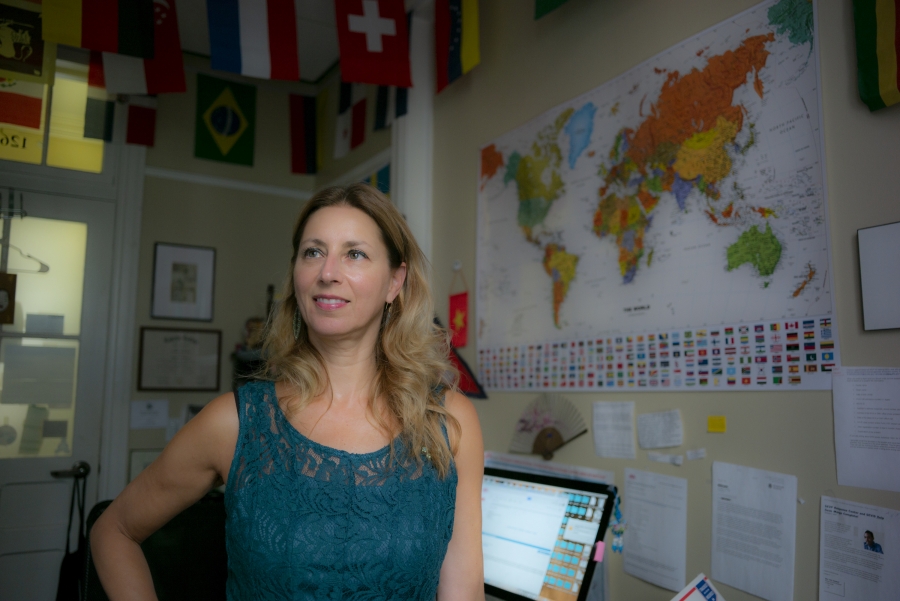
Jennifer’s (from here on in Jen) office speaks volumes even before she does: vibrant bunting representing nations from around the world line the walls, interspersed with thoughtfully chosen artworks. Cabinets neatly line one side, but opposite Jen’s desk sits a welcoming seat beneath the window, where gentle daylight bathes visitors. She rotates smoothly towards me, signalling immediate, focused attention:
UGWE: Who is Jennifer – How would you describe yourself?
First Impressions
JEN: A mother, a hard worker, hopeful about the future, caring, and empathetic. A woman who is trying her best to maintain a positive outlook on the future for immigrants, non-immigrants, and for human rights. Someone who is also trying to do better in caring for herself. Most of my life has been taking care of other people, and I am trying to also take care of myself now.
Jen’s relationship with Swarthmore began as a consultant in 2008. After the unexpected passing of the beloved International Student Adviser Gloria Evans during that year’s winter break, a temporary role became a lasting vocation. Her official entry into Swarthmore College was anything but passive, marked by a famously intense student-led interview which she recalls with a smile. “I got dressed up in my suit and everything, and the students grilled me at the Upper Tarble. It was an all-day interview and they didn’t go easy on me, but I still got the job.” The implication is clear: nothing about this job, or this community, is easy. But that rigour, that intensity, was exactly what drew her in.
Today, as the International Student Dean and Director, Jen is indispensable. Officially, she provides resources, advice, and clarity through a labyrinth of immigration policies and bureaucratic complexities. Unofficially, her role transcends administration entirely. She has become, as she quietly puts it, “a mother first”, a phrase she repeats with a gentle insistence, knowing how powerfully it resonates with her students.
Early Steps: The Journey to Swarthmore
This story honors not just Jen’s impact at Swarthmore, but the journey that made it possible. Before Swarthmore, there was Cabrini University. In 1993, Jen managed student activities there, effectively running all the student clubs and organizations. But of all her responsibilities, one captured her heart: supporting international students.
“I had always been interested in global studies,” she recollects. “I was planning on becoming a global studies teacher. Which was then called world cultures. But I got a job in higher ed, and I just loved it.” That passion led her to embrace international student support wholeheartedly. When Cabrini offered her a full-time role focused solely on working with international students, she didn’t hesitate. “I said absolutely! That’s what I want to do!”
There was, of course, a learning curve. “I had no idea about F-1 regulations,” she admits, laughing. “I had to learn everything on the job. But it was fascinating to me and I loved it.” Beyond immigration paperwork and advising, she taught a college success course for international students, helping them navigate their new environment. Her role extended beyond the campus walls, sometimes quite literally. “I would sometimes pick them up from the train station and bring them to the school for the first time in my Honda CR-V, stuffing three students in there and thinking, here we go,” she says, remembering the early days with fondness. “And I still talk to them. They should be in their 50s now – one from Jamaica, one from Saint Lucia – and we still keep in touch.”
For Jen, this work has never been just about policy and/or logistics. It has always been about people.
JEN: I stood in as a surrogate mum for one student who was an orphan, and when he got married, I was the one who did the mother-son dance with him. These are meaningful, meaningful things in my life. It’s not just about the job to me; it’s about connection.
That philosophy guided her through her years at Cabrini and now forms the bedrock of her work at Swarthmore.
A Transformative Presence
Jen’s impact on Swarthmore was not a matter of quiet continuity – it was transformative. From her earliest days, she recognized barriers that international students faced and dismantled them tirelessly. Some changes were swift, achieved through conversations and a determined nudge. Others – like establishing Curricular Practical Training (CPT) – demanded years of advocacy, strategic maneuvering, and a strong conviction in equity.
UGWE: Over your time at Swarthmore, how have you witnessed the college evolve in its approach to international students?
JEN: First of all, let me just say that when I first got here, international students were bouncing from dean to dean, only to be sent to me anyway. I thought, why are we making them go in circles? So I went to the administration and said, Why not just make me their dean? That way, it’s a one stop shop. They said, ‘Okay.’ Same thing with I20. It wasn’t part of the Intercultural Center at first, so I asked why (not)? The IC director at the time, Rafael Zapata, was like, ‘Okay.’ That’s what I love about Swarthmore. I don’t have to write a hundred policies just to get a thing done.
Not everything, however, was as easily resolved. One of the biggest barriers Jen encountered was the already alluded absence of CPT – a work authorization that allows international students to gain experience in internships and research directly tied to their field of study. This absence meant that students had to pay out of pocket for pre-completion Optional Practical Training (OPT) and forfeit valuable post graduation OPT months just to gain the same summer experiences their domestic peers could access freely.
For eight years, Jen tackled the issue head-on. The primary obstacle? Swarthmore’s lack of summer classes.
JEN: Swarthmore wanted everything to be experiential. They didn’t want it to look like students were just working. By law, international students can’t just work for the sake of earning money – it has to be tied to their studies. So I made the case for experiential learning. Exactly what Swarthmore valued.
Knowing the policy had to be implemented at the curricular level, she bypassed student affairs and went straight to the provost. The first attempt? A firm no. The second, under a different provost? Another no.
JEN: It wasn’t Swarthmore’s fault. Change is hard. I had to pitch an entire course just for international students over the summer. So I wrote the policy, then rewrote it – made sure it aligned with USCIS regulations. Then, when the third provost came in, I went to her. And you know what she said? ‘Why haven’t we done this?’
JEN (Cont): So she helped me pitch the idea to faculty at Bond Hall; I had my whole PowerPoint ready. I explained this matter, how essential it was for international students to have this experience, how it had to be credit bearing, and why they shouldn’t have to pay for it. The faculty voted – each but one voted yes (with the one abstaining). And we won! I felt like I’d won a car or something. That’s how excited I was. I jumped up and down. Then I thought, wait a minute. Compose yourself, Jennifer. You need to be professional. Even though I knew the win meant we would have to do more work, I also knew it was worth it. Because if we can make things more equitable for international students and can do it within the law, then we should do it.
This was a defining victory because it not only expanded opportunities for international students but also exemplified Jen’s philosophy: persistence in the name of equity. Today, international students can pursue internships and research without the financial burden and without sacrificing their future work options. CPT allows them to gain real-world experience while preserving the full duration of their post-graduate OPT.
FYI, pre-completion OPT costs $470 just to apply.
This was just one of many structural improvements Jen pioneered. Recognizing the financial strain many first-generation, low-income (FLI) international students faced, she made sure they knew about the supplemental loan program which provides additional financial support. Another key reform involved the Free Trip Home initiative, which previously allowed international students to travel home only after their junior year. Jen saw the need for an earlier reprieve and successfully rewrote the policy, allowing students to use the trip in the second semester of their sophomore year.
JEN: I feel like that halfway point – second semester of Sophomore year – is when the students really need it the most. The first year is already hard enough. Having that experience to go home and reconnect makes a huge difference,
She also reimagined the international student orientation. Originally a single-day event run by students, Jen gathered that it wasn’t nearly enough time for new students to acclimate. She therefore extended it to five days and designed an immersive program to help students prepare for life in a new country.
JEN: The students (who ran orientation) were doing a great job. So I wasn’t starting from scratch – there was a strong base in place. I thought that with a longer orientation period, international students would have some time to adjust, meet new people, and settle in better. It made a huge difference.
But Jen’s impact at Swarthmore extends far beyond policy.
JEN: I always tell students, You can ask me the same question a hundred times. I’ll answer every single time. If it doesn’t click the first time, that’s okay. Regulations are confusing. You deserve support. I put my heart and soul in this because if I don’t give the students information, then they won’t be able to navigate it. Right? But some will, of course. I know lots of students who will read everything and anything. But there’s always something I can break down and say this is what it means. This is what will happen. This is what you’ll need to do.
UGWE: Anything that comes to mind? A thing or two that you would say, watch out for this?
JEN: Yeah. There’s so much to watch out for. That’s the thing. I always say international students have to work three times as hard or be three steps ahead. You can’t just go out and work at Hobbs as a barista because that’s not part of your major. It’s not taking what you have learned and applying it to your job. Unless you are a hospitality major, which we don’t have here.
Sorry, Hobbs.
JEN (Cont): So, those can be mistakes, you know. Someone could end up working more than twenty hours a week on campus. You have to stay vigilant about rules and restrictions that simply don’t apply to domestic students. Students come to me with amazing questions like, ‘Oh, Jen, I want to try this. I want to do that. What if I sell cookies? I am a great baker. Is that okay?’ Well for a domestic student… Yes. Go sell your cookies. For an international? Let me explain why you may not want to do that as a business.
UGWE: So, no cookies.
JEN: No cookies. It’s all those things that students have to think about. Those are the just the ones that are coming to mind, but there’s so much more.
Jen’s openness and open-door policy at the ISC defines her approach. Whether navigating bureaucratic hurdles, guiding students through moments of personal crisis, or simply offering a space to belong, she remains a constant, steady presence. It is no wonder that alumni scattered across the world still return to Swarthmore, still find their way back to her office – where the flags still hang, the light still filters through, and the door, like Jen herself, is always open.
Speaking of open…
Finer Strokes of the Portrait
You could be forgiven for not knowing that in 2014, Jen opened herself and stepped into an unexpected spotlight as a judge on the Chinese English Talent Competition, Star of Outlook. It’s not everyday your International Student Dean moonlights as a talent show judge, but then again, Jen has never been one to fit neatly into a single role. Picture a warmer, more compassionate Simon Cowell with a heart attuned to the rhythms of global talent.
JEN: Swarthmore has sent me places and I have been able to travel and I am super thankful for that. I went to Beijing, China. You know, I was on a television show as a talent judge.
UGWE: Oh wow. Tell me more about that.
JEN: Sure. I had the honor of representing Swarthmore as a judge alongside peers from Cambridge University, King’s College (London), The University of Sydney, and The University of Wollongong. It was a talent show to be specific and they placed this translation earbud in my ear. And I had to act; I had to go out on stage; I also ended up being at the center of their advertising poster.

UGWE: That is really interesting!
JEN: I have been teased about it before. It was on Swarthmore’s website for a while. I think it still is. We filmed till about one in the morning. They did my hair and it was also the first time I wore fake eyelashes. They put that on me and did the rest of my makeup. I met amazing people. It was all great fun. I also made sure I did a few things in the city on my own. I experienced what it was like to use their metro. And I, you know, of course, got lost a couple of times. I ate a scorpion; I ate duck tongue; I went to a few temples. I wouldn’t have been able to do that without Swarthmore.

JEN (Cont): I could never have thought that I would be able to do such amazing things. Swarthmore also sent me to Berlin. I took a class for two weeks there. I went to the Fulbright Fair in London. I went to the UWC schools located in castles, one in Wales and another in Italy. When I was in Italy*, I was trying to find my way back to the hotel. And there was a student who said to me, ‘I’ll get on the bus with you and make sure you get back.” Well, he ended up getting accepted to Swarthmore. At the fair in London, there was a student I met who really stood out and ended up coming here and is now doing a PhD program in Ohio. So I remember things like that. I can see them perfectly.
*I took great pains to write something along the lines of ‘when in Rome.’ Admittedly, unsuccessful.
Lessons in Compassion
UGWE: You’ve spent so many years supporting students who have been going through major transitions in the US. When you reflect on your own life, can you think of some significant transitions you have navigated yourself, and how this has influenced your approach to how you support Swatties?
JEN: First, I would like to say that as a child I moved around a lot. So I went to three different elementary schools, two different junior highs, and I think I always had to meet new people and acclimate to new environments. Even though English was the language – I can only imagine how difficult it can be when it’s not your first language. But I did have different cultures that I had to adapt to, different states, different situations. My mom was a school teacher and she is my role model, always helping and supporting. So I think that also influenced me. Without getting too much into my childhood, I had a lot of struggles. So for me, I can be a little bit more patient and understanding because nothing came easy for me. I also don’t look at you as someone who’s super smart who made it to Swarthmore. I look at you as a human being who might need some support knowing very well that everybody is going to have some barriers.
UGWE: That’s a wonderful perspective. And I think it’s safe to say that this has always been the case for you. Whether it’s working with internationals at Cabrini, or those of whom you assisted as a consultant, or Swatties.
JEN: Absolutely!
UGWE: Continuing along that line of thought – drawing on your wealth of experience working across institutions and cultures, how would you characterize Swarthmore students? Are there qualities or tendencies you have observed that feel distinct?
JEN: That’s such an interesting question because they asked me that question in my interview. The committee asked me that same exact question. Here is what I said. I said not really because these are young minds between the ages of 18 to 23. They’re all developing and growing, and they’re students. Right? Do I think there’s that much of a difference? Not really because, again, you’re here to learn. So I take each student individually.
UGWE: Quite the answer for an interview. I am taking notes…
JEN: But I think that for me, I have such amazing conversations with Swarthmore students. Things that are happening in the world, what their interests are… I walk from this building to another with students and we’ll have these great conversations and they will ask me really good questions. So I can say that I haven’t had that anywhere else as much as I’ve had it here. But it’s hard to say, you know, because I do not want to compare.
UGWE: Quite a diplomatic way to put it. Do you feel like there has been some shaping of who you are personally over the years here?
JEN: Yes! I can definitely say that my life is better because of you – our students. I have experienced so much personal growth and learned so much from students. I just feel like I would not be who I am if it wasn’t for this community, this place, and this occupation. And that is why it is so easy for me to want to work seven days a week and be involved. To a certain point, I always let students decide how much time they would like to sit in this office and talk to me on things. If I do not see them, I am just happy to know they are well. Yes, it has completely enhanced my life.
A Legacy of Care: A Message Across Generations
As our conversation drew to a close, sunlight still streamed through the window of Jen’s office, casting soft light across the flags and artwork that surround her daily. The hour had slipped by with the ease of old friends in conversation, and just as I prepared to stand, she paused, her eyes beaming with a sudden thought.
“I did want to add something I am really proud of,” she said, her voice tinged with animation. “I’m afraid to jinx it, but here goes: For the past 16 years, every international student who was accepted and chose to enroll at Swarthmore got their visa. No final denials. That’s something! So I feel the ISC and the students worked harmoniously as a team, and were properly prepared for the interview questions and had their documents in order. That statistic to me is very impressive. I hope our record holds strong in this ever changing environment.
Jen’s measured pride, hinted at in her hesitation to tempt fate, is more than warranted. It reflects a deep attunement to the lived realities and anxieties of the students she serves. In a world where immigration policies are shifting sands and F-1 visa denial rates have climbed from 15% in 2014 to 36% in 2023, her words carry the weight of both vigilance and hope. The ISC’s remarkable record is no fluke. It is the result of careful preparation, sustained care, and an unwavering belief that even in an unpredictable landscape, collective effort and determination matter. In this spirit, Swarthmore – and Jen – remain committed to ensuring that international students not only arrive but also find security, support, and the freedom to thrive.
UGWE: If you could craft one message from your work to resonate with every international student who has passed through Swarthmore College, what would that message be?
JEN: You are a gift to Swarthmore, and you are a gift to the world.
As I stepped out of her office, flags still fluttering gently along the walls, I could not help but feel that Jennifer Marks-Gold is more than a dean or advisor. She is a steward of journeys and an architect of countless lives far from home, including my own.
It is a wonder how so large a heart can be compressed into so compact an office.
Leave a Reply